These are my notes on chess strategies. I am not a highly rated chess player, so these are just guidelines that beginner to intermediate players might find useful.
Strategies
-
Attempt to control the center of the board.
The board below shows some ideal positions for pieces that have been developed to control the center of the board. Of course your opponent will likely not allow you to move to these positions but it is a good goal.
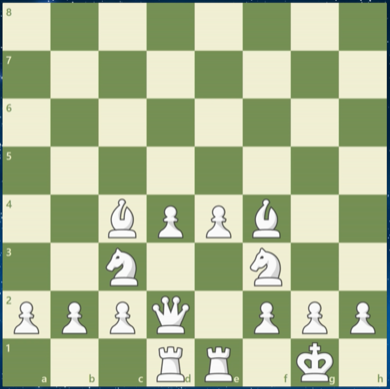
-
Castle before attacking.
-
Don’t push kingside pawns more than two ranks away from king.
-
Don’t take the queen out too early.
-
Trade side pawns (files C and F) for center pawns (files D and E).
-
Look for potential attacks from opponent, especially ones that put you in check AND threaten other pieces.
-
Count the number of pieces attacking and defending each square and consider the values of the pieces that would be exchanged.
-
When planning the next move, verify that it isn’t weakening the defense of your pieces.
-
Avoid blocking your own pieces, especially behind pawns.
-
Avoid pawn attacks that result to multiple pawns in the same file (doubled) unless doing so wins a piece.
-
Watch for “en passant” pawn captures.
-
Avoid placing knights on the edge of the board because that leaves them with fewer target squares.
-
Try to move rooks to open files and connect them so they protect each other.
-
Bishops ar better in open positions and knights are better in closed positions.
-
Having two bishops and no knights is typically slightly better (half point) than having only two knights or having only one bishop and one knight, but it depends on whether the board is in an open of closed position.
-
Plan and defend against forks.
-
Plan and defend against skewers such as pinning a piece to the king or queen.
-
Plan and defend against discovered attacks.
-
Avoid moving the same piece twice because it loses a tempo (turn).
-
Usually avoid moving backwards.
-
Try to be more aggressive (attacking or forcing a response) than passive (defending).
-
Don’t swap pieces if no advantage is gained, i.e. don’t trade a piece with a good position for a piece with a lesser position.
-
Utilized the king in the end game, especially to protect pawns.
-
Utilize “head on a stick” moves where a piece is defended by a pawn that is one rank behind it.
-
Sometimes it is good to take a piece that is protected because if they take back they expose a more valuable piece.
-
Activate your king in the end game, especially when the opponent queen has been captured.
-
A stalemate occurs when a players king is not in check and they have no legal moves. Avoid putting the opponent in this position when winning and try to get into this position when losing.
Notation
King = K Knight = N Queen = 0 Rook = R Bishop = B Pawn = just square moved to Capture = X Check = + Checkmate = # Castle Kingside = 0-0 Castle Queenside = 0.0.0