Overview
Smalltalk provides many methods for getting information about classes and objects. The following table lists some of them.
| Method | Answers |
|---|---|
object class | the class of object |
object instVarNamed: #varName | the value of an instance variable in object |
object instVarNamed: #varName put: newValue | sets value of an instance variable in object and answers new value |
object class = SomeClass | answers Boolean indicating if object is an instance of the class SomeClass (not one of its subclasses) |
object isKindOf: SomeClass | answers Boolean indicating if object is an instance of the class SomeClass or one of its subclasses |
object respondsTo: #selector | answers Boolean indicating if the object responds to a given method selector |
SomeClass name | the name of the class as a String |
Smalltalk allClasses | an Array of all classes defined in the current image |
Smalltalk allClassesImplementing: #selector | an Array of all classes that implement a given selector |
SystemOrganization categoryOfElement: #SomeClass | name of the class category to which a given class belongs |
SomeClass allClassVarNames | a Set of class variable names defined in this class |
SomeClass allSelectors | an IdentitySet of all message selectors (as Symbol objects) supported by this class, including selectors in superclasses |
SomeClass lookupSelector: #selector | the matching CompiledMethod, indicating where it is found |
SomeClass allInstances | an Array of all existing instances of this class |
SomeClass allInstVarNames | an Array of instance variable names defined in this class |
SomeClass allInstVarNamesEverywhere | an Array of instance variable names defined in this class and inherited classes |
SomeClass allMethodsInCategory: 'some-category' | an Array of instance methods in a given category, including those defined in this class and inherited |
SomeClass allSubclasses | an OrderedCollection of subclasses |
SomeClass superclass | a Class that is the superclass of this class |
SomeClass withAllSuperclasses | an OrderedCollection containing all superclasses of this class going up the hierarchy |
SomeClass allSuperclasses | an OrderedCollection of superclasses |
SomeClass selectors | an Array of all instance method selectors (as Symbol objects) of this class |
SomeClass class | the Metaclass subclass of this class |
SomeClass class selectors | an Array of all class method selectors (as Symbol objects) of this class |
SomeClass class allMethodsInCategory: 'some-category' | an Array of class methods in a given category, including those defined in this class and inherited |
CodeListPackages installedPackages | an Array of CodePackage objects (appear in System Browser class category pane) |
thisContext sender | a MethodContext describing the method that invoked the current one |
someMethodContext receiver | the object that sent the message that invoked the MethodContext |
someMethodContext selector | the selector Symbol of the message that invoked the MethodContext |
someSelector keywords | an Array of the keywords in the selector |
Getting Keywords from Selectors
The following examples demonstrate getting keywords from a message selector:
#foo keywords. "#('foo')"
#foo:bar:baz: keywords. "#('foo:' 'bar:' 'baz:')"
Operating on All Instances
To run code on every instance of a given class,
send the allInstancesDo: message to the class.
For example, to delete all instances of a given class, run
SomeClass allInstancesDo: [:obj | obj delete].
Sending Messages
See the “Dynamic Messages” section in the “Messages” page.
This describes how to use perform: to send messages to objects
where the selector is a Symbol.
Finding the Method for a Selector
There isn’t a provided method that finds the nearest class in the
inheritance hierarchy that implements a method with a given selector.
I added the following method to do that.
It is in the Behavior class in the method category “*TypeCheck”,
so it is saved in the TypeCheck package.
lookupClassImplementingSelector: selectorSymbol
    "Look up the given selector in my methodDictionary.
    Return the class that implements it if found.
    Otherwise chase the superclass chain and try again.
    Return nil if no implementing class is found."
    | class |

    class := self.
    [class == nil] whileFalse: [
        class includesSelector: selectorSymbol :: ifTrue: [^ class].
        class := class superclass
    ].
    ^ nil
Finding Methods by Example
The Squeak development environment provides a way to find methods by example using the “Method Finder” tool (a.k.a. Selector Browser).
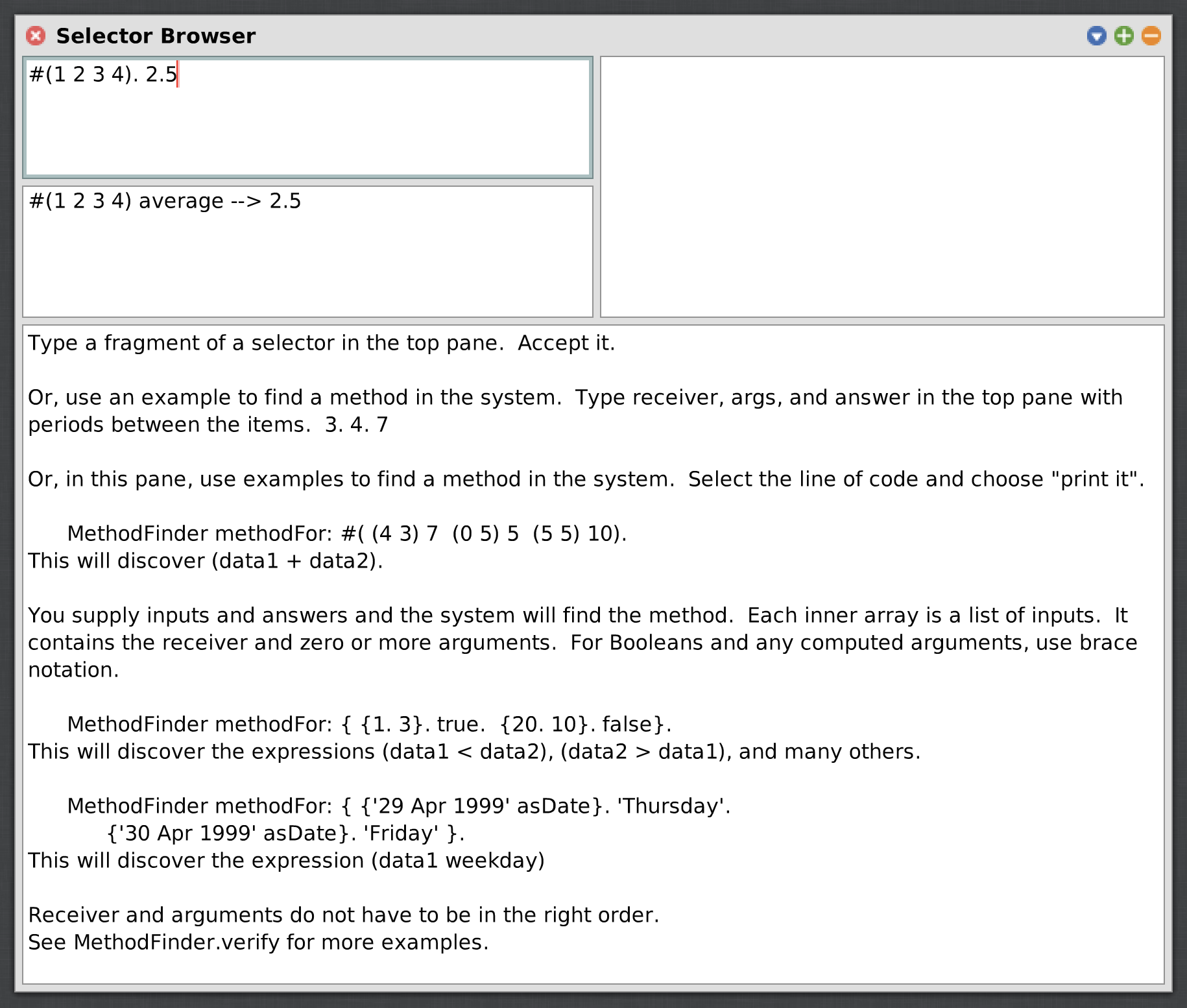
I implemented similar functionality in Cuis, minus the GUI. See Cuis-Smalltalk-FindByExample. It’s amazing how fast this is!
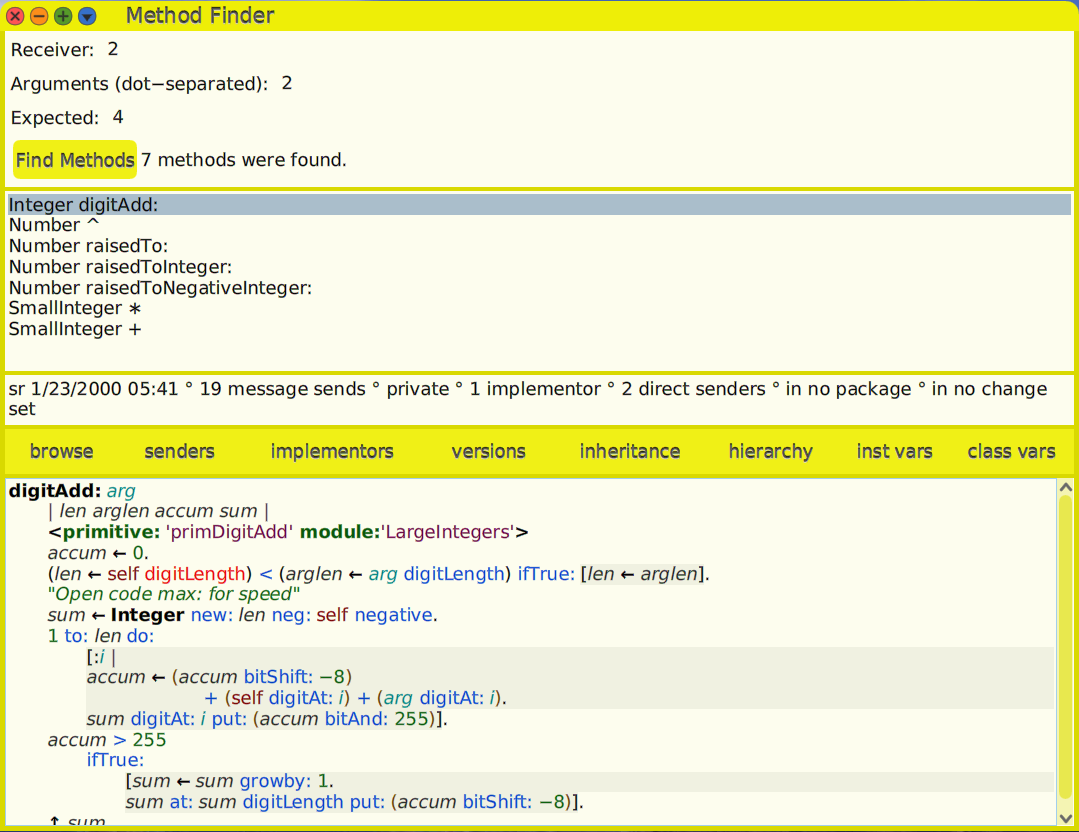
For example, evaluating the following in a Workspace:
Finder methodsByExample: #(#(1 2 3 4) 2.5)
prints the following in the Transcript:
The following methods on #(1 2 3 4) with no arguments return 2.5:
- average
- mean
There are more examples in the README.
Questions
TODO: Why does allClassVarNames return a Set when allInstVarNames returns an Array?
TODO: Is there a way to get all the message categories used by a class?